Folk01: model judges
Interpretation update, 2026-09-07: The psychology literature changes the construct definitions. These judge results measure label application; they do not establish clinical flat affect or psychological introversion.
The definition reverses the introversion verdict
Three OpenRouter judge families scored anonymous transcripts. We have 395 valid scoring responses from 396 requested cells, plus three definitions written before the judges saw any text. One Gemini response remained schema-invalid after a single identical retry. Its ratings are missing, not zero. All 24 generated conversations remain unchanged. Total reported API cost, including format probes and retries: $3.60.
On the same full warm-specific conversations, every judge ranks Hermes most introverted under its own definition, and least introverted under the supplied definition. These are the judges' ratings, not established model personality types. The supplied wording changes the measurement substantially.
| Judge | Checkpoint | Introverted: own meaning | Introverted: supplied meaning | Flattened: own meaning | Flattened: supplied meaning |
|---|---|---|---|---|---|
| Sonnet 5 | Official | 0.00 | 1.75 | 1.38 | 1.38 |
| Sonnet 5 | Hermes | 2.88 | 0.88 | 2.88 | 2.88 |
| Sonnet 5 | Huihui | 0.00 | 1.25 | 1.62 | 2.00 |
| Gemini 2.5 Flash | Official | 0.12 | 2.38 | 1.12 | 0.12 |
| Gemini 2.5 Flash | Hermes | 1.50 | 0.12 | 2.25 | 2.38 |
| Gemini 2.5 Flash | Huihui | 0.12 | 3.00 | 1.12 | 0.12 |
| DeepSeek V3.2 | Official | 0.62 | 3.62 | 0.88 | 0.50 |
| DeepSeek V3.2 | Hermes | 3.12 | 0.50 | 3.50 | 3.50 |
| DeepSeek V3.2 | Huihui | 0.88 | 3.62 | 0.62 | 0.38 |
Scores run from 0 (no fit) to 4 (very strong fit). Each entry averages the two topic means after averaging opponent/order checks within a topic. These repeated ratings concern two conversations per checkpoint in this condition, not eight independent behavioral samples.
All three judges' initial definitions make introversion mostly brief, reactive, and unlikely to volunteer. The supplied definition adds becomes specific or expressive when drawn out, with appropriate carryover. No human usage was surveyed. Read the exact definitions: Sonnet, Gemini, DeepSeek.
Longer exposure does not have one agreed effect
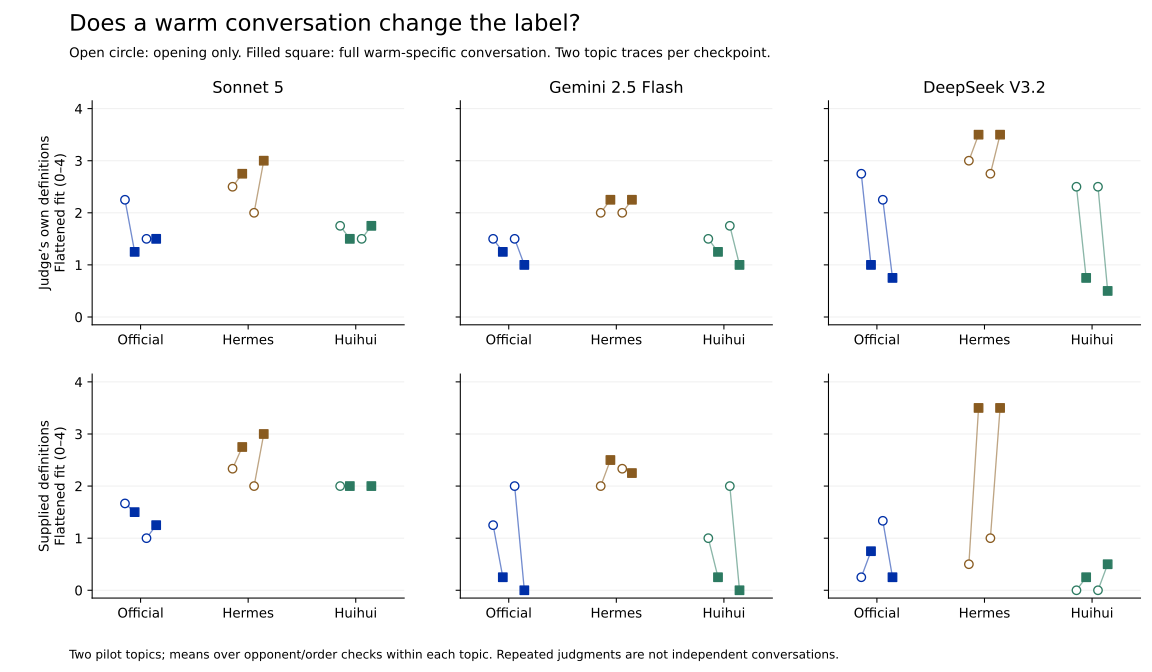
P22 predicted a lower official-Qwen flattened score after the full warm-specific conversation, under supplied definitions. Gemini follows that prediction on both topics. Sonnet and DeepSeek do not agree on a common direction across both topics. Their opening-only unknowns also limit the numerical comparison.
| Judge | Topic | Official: opening → full WS | Difference | Bounds with opening unknowns |
|---|---|---|---|---|
| Sonnet 5 | library | 1.67 → 1.50 | -0.17 | -0.75 to +0.25 |
| Sonnet 5 | walk | 1.00 → 1.25 | +0.25 | -2.00 to +1.00 |
| Gemini 2.5 Flash | library | 1.25 → 0.25 | -1.00 | -1.00 to -1.00 |
| Gemini 2.5 Flash | walk | 2.00 → 0.00 | -2.00 | -2.00 to -2.00 |
| DeepSeek V3.2 | library | 0.25 → 0.75 | +0.50 | +0.50 to +0.50 |
| DeepSeek V3.2 | walk | 1.33 → 0.25 | -1.08 | -1.75 to -0.75 |
Differences use available numerical ratings; bounds replace each unknown with either 0 or 4. They are not confidence intervals. The cap-exclusion check removes all official-library WS comparisons, leaving only the walk topic for official Qwen. It cannot settle the two-topic question. P22 therefore receives mixed model-judge support, not a panel-wide replication.
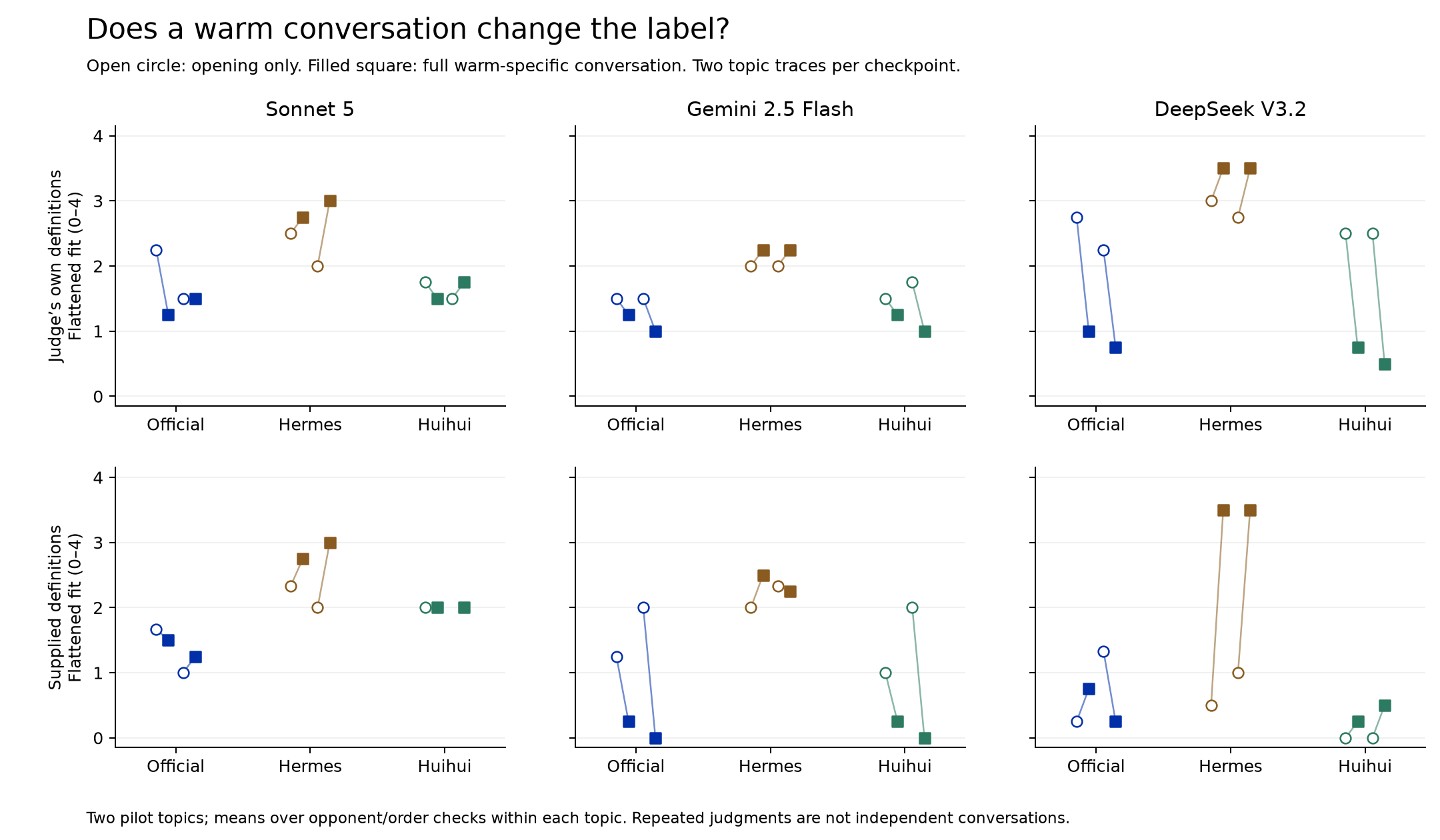
Vector figure. Each subplot has the same 0–4 scale. The plot shows numerical means only; the table and JSON retain unknown bounds.
The behavioral axes still separate useful things
Separate paired semantic requests compare generic and specific branches at fixed checkpoint, topic, and warmth. Scores run 0–2. All three judges score every checkpoint as more responsive to personal details in the specific condition. This does not imply accurate advice. Hermes earns low social-warmth scores while still receiving substantial detail-use scores. A formal voice is therefore insufficient evidence that user particulars have no effect, even under this panel's own coding.
| Checkpoint | Judge | Warm minus neutral at T4 | Warm minus neutral at T5 | Warm minus neutral at T7 | Specific minus generic detail use at T7 |
|---|---|---|---|---|---|
| Official | Sonnet 5 | +1.00 | +0.25 | +0.75 | +1.75 |
| Official | Gemini 2.5 Flash | +0.75 | +1.00 | +1.00 | +2.00 |
| Official | DeepSeek V3.2 | +0.75 | +0.75 | +0.75 | +2.00 |
| Hermes | Sonnet 5 | +0.25 | +0.25 | +0.25 | +1.75 |
| Hermes | Gemini 2.5 Flash | +0.25 | +0.00 | +0.00 | +2.00 |
| Hermes | DeepSeek V3.2 | +0.25 | +0.25 | +0.25 | +1.75 |
| Huihui | Sonnet 5 | +0.75 | +0.00 | -0.25 | +1.00 |
| Huihui | Gemini 2.5 Flash | +0.50 | -0.25 | -0.25 | +1.75 |
| Huihui | DeepSeek V3.2 | +0.75 | -0.25 | -0.25 | +2.00 |
These are means of two topic contrasts, each with two matched branch pairs. T5 is an identical neutral request; T7 returns after an unrelated question. Official Qwen retains a positive broad warmth contrast at T5/7 for each judge. Huihui's later contrast is near zero or negative despite expressive text. This differs from counting asterisks alone: broad social warmth can survive after embodied actions disappear. Full scores for volunteering, stance, context errors, correction and criticism remain separate in analysis.json.
Within this pilot, higher warmth and longer responses associate more strongly with lower flattened ratings than consequential detail use does. Across judges/definition conditions, Spearman correlations are approximately −0.52 to −0.88 for warmth, −0.60 to −0.79 for length, and −0.14 to −0.35 for detail use. Emoji rate is also strongly associated. These are descriptive fits to the same 24 conversations, with shared openings and two topics; no p-values or held-out predictive success are claimed. Length and style remain competing explanations for the label. No new lens target is validated.
Audit the judges too
A/B reversal preserves the flattened choice in 47/60 Sonnet pairs, 51/59 Gemini pairs, and 47/60 DeepSeek pairs. For introverted the counts are 47/60, 46/59, and 49/60. These counts include tie and insufficient choices. Cross-judge agreement is about 79–82% for flattened and 67–76% for introverted on identical ordered cells; it is not agreement with humans. Repeated order checks do not enlarge the behavioral sample.
211 of 395 responses contain at least one non-exact evidence quote. Some only change whitespace, Markdown or quotation marks; others paraphrase or combine passages. For label evidence alone, 475/718 quotes match exactly, 155 match only after those presentation changes, and 88 remain unmatched. Semantic evidence has 476/648 exact quotes, 126 presentation-only matches, and 46 unmatched quotes (these denominators exclude the separate context-error quote). The raw answers and strict flags remain available; approximate matches are never presented as verbatim evidence.
An exploratory exact-quote-only check is selective: it removes many expressive replies and leaves some Sonnet/DeepSeek cells with zero or one rating. Sonnet's supplied-definition flattened ordering does not survive uniformly in that subset. Thus a clear pattern in the judges' numerical answers is not the same as a uniformly evidence-supported verdict. Quote counts and restricted cells.
The known arithmetic item catches a substantive coding problem. Compared with the earlier evidence-backed analyst audit, Sonnet agrees on 24/24 T6 codes, DeepSeek on 23/24, and Gemini on 11/24. Gemini often awards an ambiguous code to an unqualified wrong answer. DeepSeek treats Huihui's mixed correction as clear. Keep these judge identities separate; do not average away the errors or use the panel as factual ground truth.
The main transport returned 396 responses. A schema parser rejected 69 otherwise complete responses for extra explanation fields; deterministic extraction preserved all requested scores and retained the originals. One missing required field remained invalid after its sole retry. All format-only probes, failed responses, parameter changes, and analysis amendments are in the judge protocol. Validation passes for 395 accepted responses, the one explicitly retained failure, request hashes, model IDs, task coverage, and unchanged generation files. Verification, exact task manifest.
This gives a reproducible answer to the current measurement question: score volunteering, social adaptation, useful detail uptake and continuity separately; measure the labels under explicit wording conditions. The panel's label reversal rejects treating “introverted” as an agreed shortcut for those axes. The earlier human-rating plan is retired. Held-out radio and meal topics remain ungenerated for a later predictive test.
2026-09-07 follow-up: Folk02 rejudges these texts with separate expression, initiative and stance measures, using Surplus model judges. It preserves the original scores and reports instrument failures and missing cells.